
Sliding or double-leaf swing? Opening types for villa driveway gates
This gets asked as if it were a question of taste, but the answer lies in the geometry of the entrance. Each of the three opening types exists to solve a particular constraint; which one suits you depends on how much room is left in front of and beside the gate.
First, take these three measurements
Before getting into the debate over opening types, you need three numbers. Without them, any comparison stays theoretical.
- Opening: the clear distance between the two columns.
- Side run: the straight, uninterrupted distance along the wall from where the opening ends.
- Front depth: the clear area in front of the gate, toward the street.
These three numbers rule out options straight away: with no side run there can be no sliding gate, and with no front depth there can be no double-leaf swing gate.
Tracked sliding: the solution that needs a side run but no front space
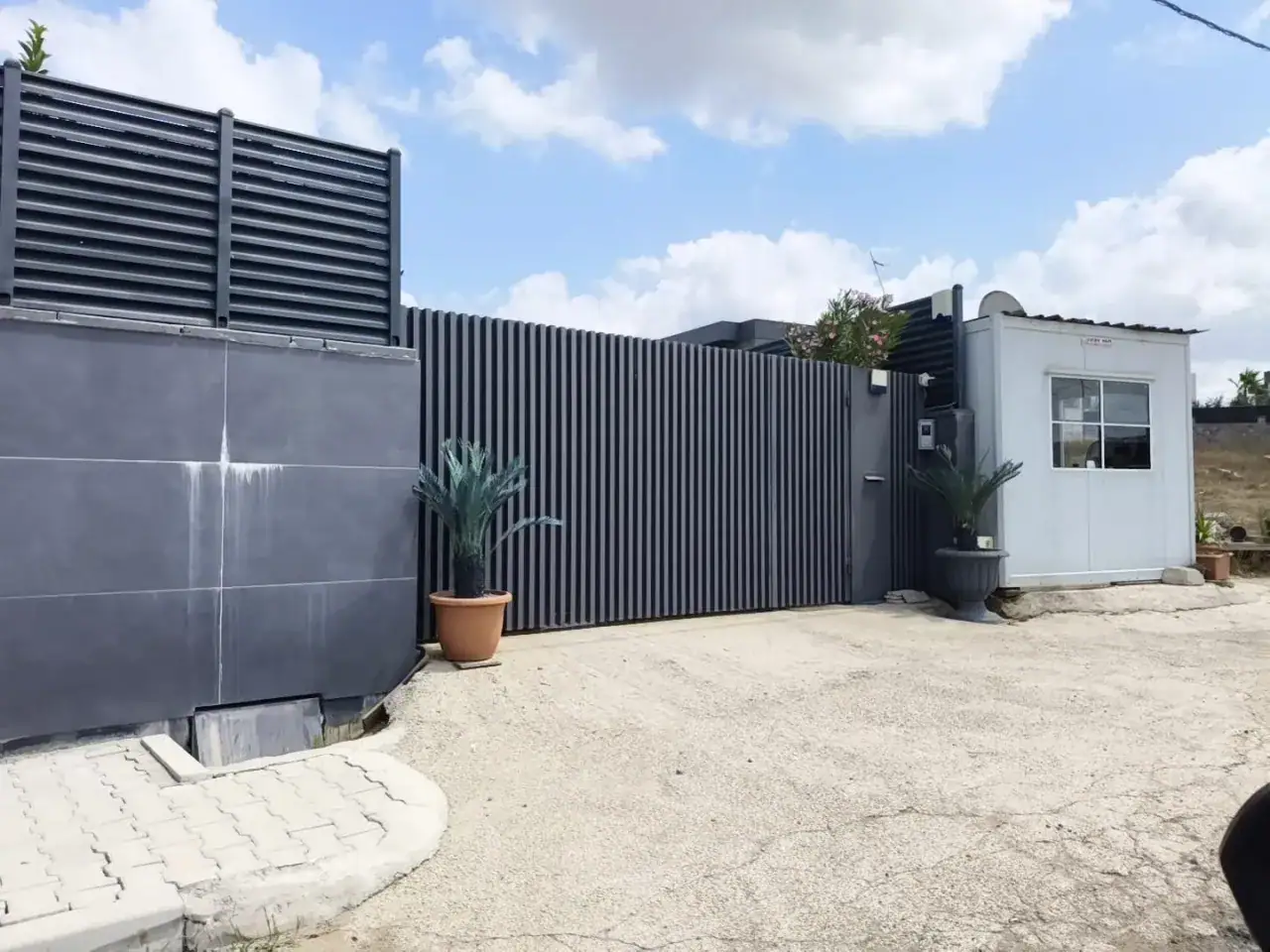
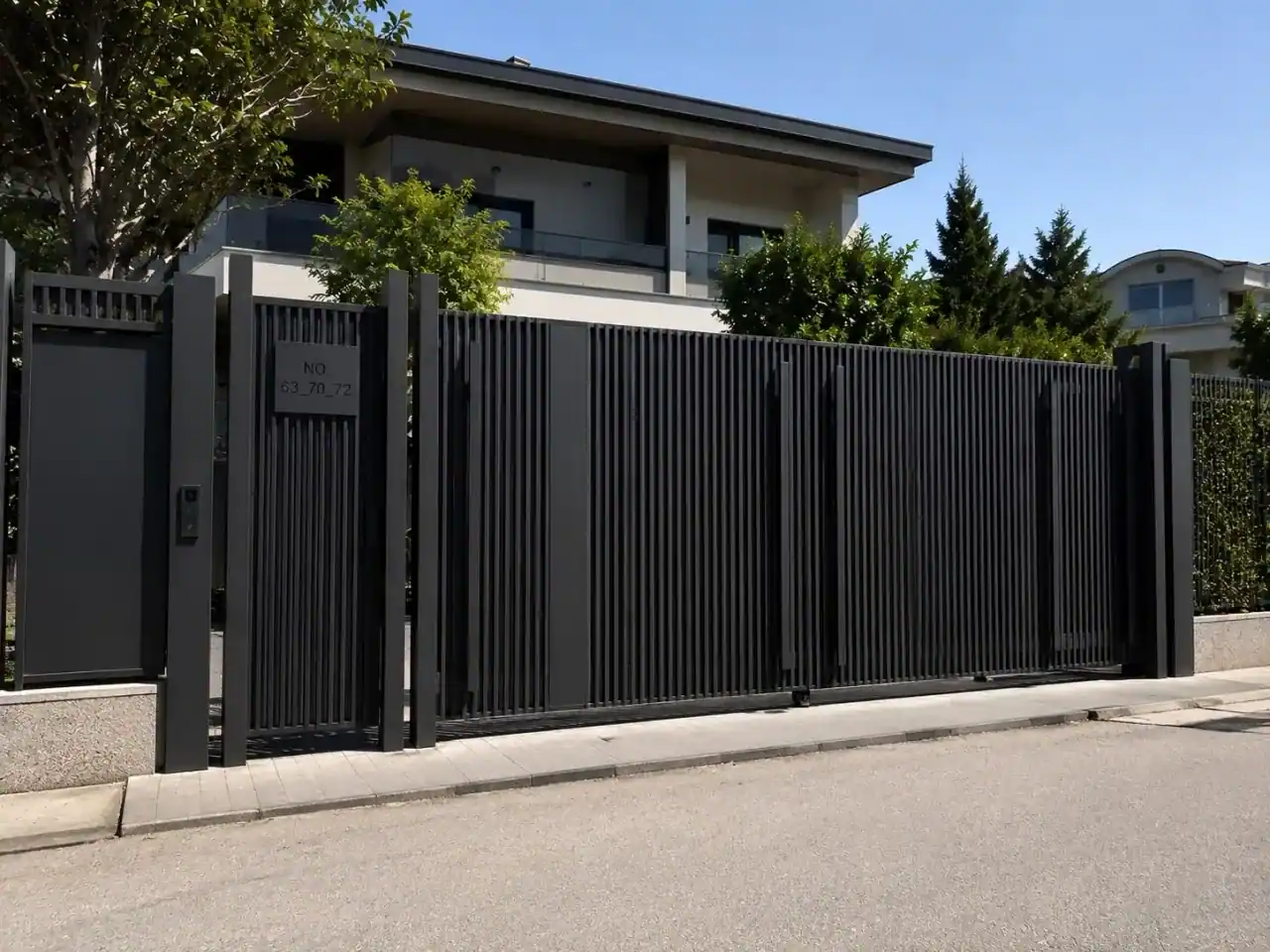
On a tracked sliding gate, the leaf rolls sideways on wheels along a track set into the ground. It needs no space at all in front of the gate, which is why it is the first solution that comes to mind where cars park in front of the gate, the street is narrow or the entrance is on a ramp.
What it asks for in return is a side run: the gate must be able to slide along the wall without interruption for a distance equal to its width. If there is a tree, a pole, a projecting column or a change in level along that run, the system will not work there.
The second thing to watch is the track itself. Because it is set into the ground, water, soil and leaves collect in it; a track laid without any thought for drainage starts to strain the gate after a few seasons. On a track that freezes in winter, the gate may not open at all. That is why the slope and drainage of the track run are a matter for the site survey, not for fabrication.
Suitable for
Entrances with little room in front, ramped entrances, entrances where cars park in front, and wide openings in frequent use.
Not suitable for
Entrances where the side run is obstructed or short, and ground with a large level difference that cannot be corrected.
Cantilever sliding: the sliding gate that never touches the ground
A cantilever sliding gate removes the ground problem of the tracked system: there is no track on the ground, and the gate is held clear of it, sliding sideways, balanced by the counterweight section at the back. That is why it is chosen for entrances with uneven levels, entrances that take on water and entrances that freeze in winter. It also has an advantage in areas that get snow — there is no track on the ground to clear.
The trade-off comes down to two things. First, it needs a heavier, stronger frame for the same opening; because the gate is carried entirely on its own cantilever, the sections get larger. Second, it needs extra space at the back for the counterweight — in other words, the side run has to be longer than for a tracked system. At an entrance with a short side run, a cantilever gate is harder to fit than a tracked one.
Suitable for
Entrances with uneven ground levels, or ones that take on water or freeze; locations where a track cannot be maintained.
Not suitable for
Entrances with a short side run; small openings where you would rather not see the frame weight reflected in the cost.
Double-leaf swing: the classic-looking solution that needs front space
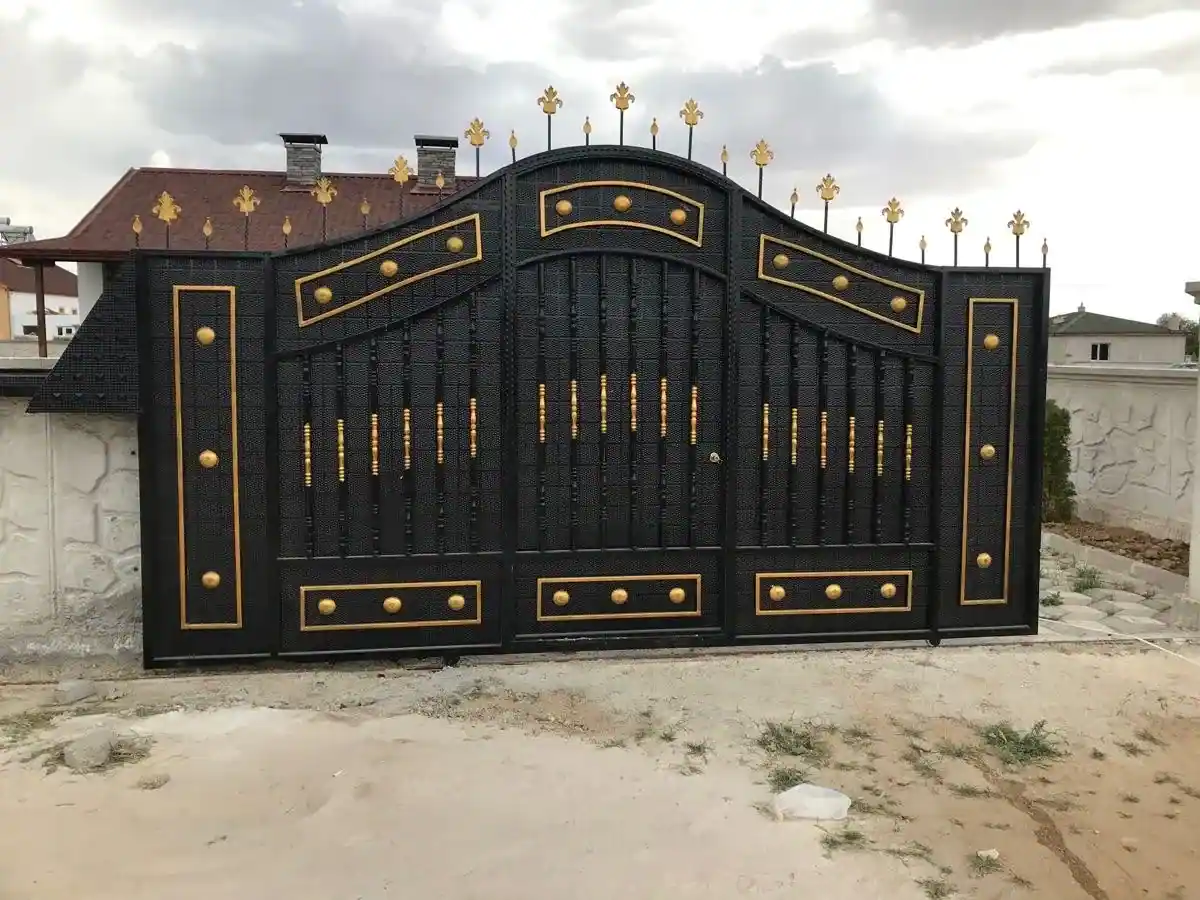
A double-leaf swing gate opens in two halves from the middle. It is the oldest and most familiar solution, and on facades with classic lines, stone cladding and wrought iron details it is the type that sits most naturally with the architecture. Mechanically, it is also the simplest system: no track, no wheels, no cantilever — only hinges.
What it needs is front depth. Each leaf sweeps an arc as wide as the leaf itself, and the area inside that arc has to be clear every time the gate opens. A car parked in front of the gate, a narrow street or a ramped entrance turns this system into a daily annoyance.
The second issue is wind. Each leaf catches the wind separately, and an open leaf can be swung by a gust; this wears the hinges and over time leads to sagging. In windy locations, gate stops — and, if needed, an infill with gaps — become part of the conversation.
Suitable for
Entrances with enough clear space in front; classic facades and facades with wrought iron details; openings of medium width.
Not suitable for
Narrow streets, ramped entrances, entrances where cars park in front; very wide single openings.
What is the difference on the automation side?
All three types take a motor, but the motors are not the same. On a sliding gate, the motor usually sits to one side, at the start of the track run, and pushes and pulls the gate by means of a gear rack. On a double-leaf swing gate, each leaf needs its own motor: either a ram type or an articulated-arm type. In other words, on the automation side a double-leaf gate means two motors, and that shows in the cost.
The second difference is maintenance. On a sliding system, the parts that wear are the wheels and the track; kept clean, it runs trouble-free for a long time. On a double-leaf gate, the wear points are the hinges and the motor mounting points; because the weight of the leaf always bears on the same spot, it needs adjustment over time.
In a power cut, both can still be operated by hand with the manual release key. The difference is this: pushing a sliding gate by hand is usually easier, because the weight sits on the wheels; opening a heavy double-leaf gate by hand takes more effort.
Decision table: which constraint points to which type?
The pairings below summarize the situations we come across most often on site. If more than one constraint applies, the decision follows whichever comes first in the list.
Little room in front, or a ramped entrance
Sliding (tracked or cantilever). A double-leaf swing gate causes problems here every day.
Side run short or obstructed
Double-leaf swing. If there is nowhere for a sliding gate to slide, the system cannot be installed.
Uneven ground, or ground that takes on water
Cantilever sliding. With a tracked system, the track run causes problems.
Very wide opening
Sliding. A wide double-leaf gate strains its hinges because of the weight of the leaves.
Classic / stone-clad facade
Double-leaf swing, with wrought iron details. Here the architectural language may be the deciding factor.
Location exposed to wind
Whatever the type, choose an infill with gaps; on a double-leaf gate, gate stops are a must.
Can you change the type later?
In practice, it is very difficult. Switching from a double-leaf swing gate to a sliding gate means cutting a track into the ground or clearing a side run for a cantilever; the columns are often in the wrong place as well. The reverse is similar: fitting a double-leaf gate to a sliding-gate opening requires columns that are suitable for hinges.
That is why the opening type is not a preference you can change later, like the color or the infill of the gate; it is a decision that belongs to how the entrance itself is built. If you are undecided, take one photo from in front of the entrance and one from the side and send them with the measurements; we will write back which type fits there, and which does not and why.
Two other options: single-leaf and folding
Beyond the three main types there are two more solutions, both for a narrow set of needs.
A single-leaf driveway gate is used at entrances with a small opening. Because the leaf is as wide as the whole opening, it needs twice the front depth of a double-leaf gate on the same opening; and because it is a single piece, the weight of the leaf bears on one set of hinges, so the risk of sagging grows quickly as the width increases. It makes sense for narrow entrances, not for wide openings.
A folding gate is one whose leaf folds in two on itself as it opens. It uses little front space and little side run; it is the answer for tight entrances where both are limited. The trade-off is mechanical complexity: more hinges, more adjustment points and therefore more maintenance. When we do recommend a folding gate, there usually really is no other option left.
Which one is less trouble in the long run?
Looked at over a five-year window, the three types have clearly different maintenance profiles.
On a tracked sliding gate, the parts that wear are the wheels and the track. If the track is kept clean, the system runs trouble-free for a long time; if it is neglected, a fault is inevitable, because built-up soil strains the wheels. In short: easy to maintain, but with little tolerance for neglect.
A cantilever sliding gate has no track on the ground to keep clean; it is the type with the lowest maintenance burden. On the other hand, because the supporting structure and the counterweight section are more complex, repairs are more technical when a fault does occur.
On a double-leaf swing gate, the wear point is the hinge. Because the weight of the leaf always bears on the same spot, it needs adjustment over time; the adjustment is simple, but if it is not done regularly the gate starts to drag and the lock stops catching. In a windy location without gate stops, hinge life is noticeably shorter.
All three have one thing in common: the problem almost always starts in the mechanics and shows up in the motor. If the gate is hard to move by hand, replacing the motor is not the answer.
Pages related to this article
Models mentioned in this article
Let’s talk about your project
This article covers general cases; your entrance, plot or building comes with its own constraints. Send us measurements and photos, and we’ll tell you which solution fits.