
Mesh panel fence or louvered fence? A comparison
Both are fences, but they don’t do the same job. One marks a boundary, the other blocks the view — and that difference changes not only the look but also the post section, the footing depth and the cost per meter.
The key difference in one sentence
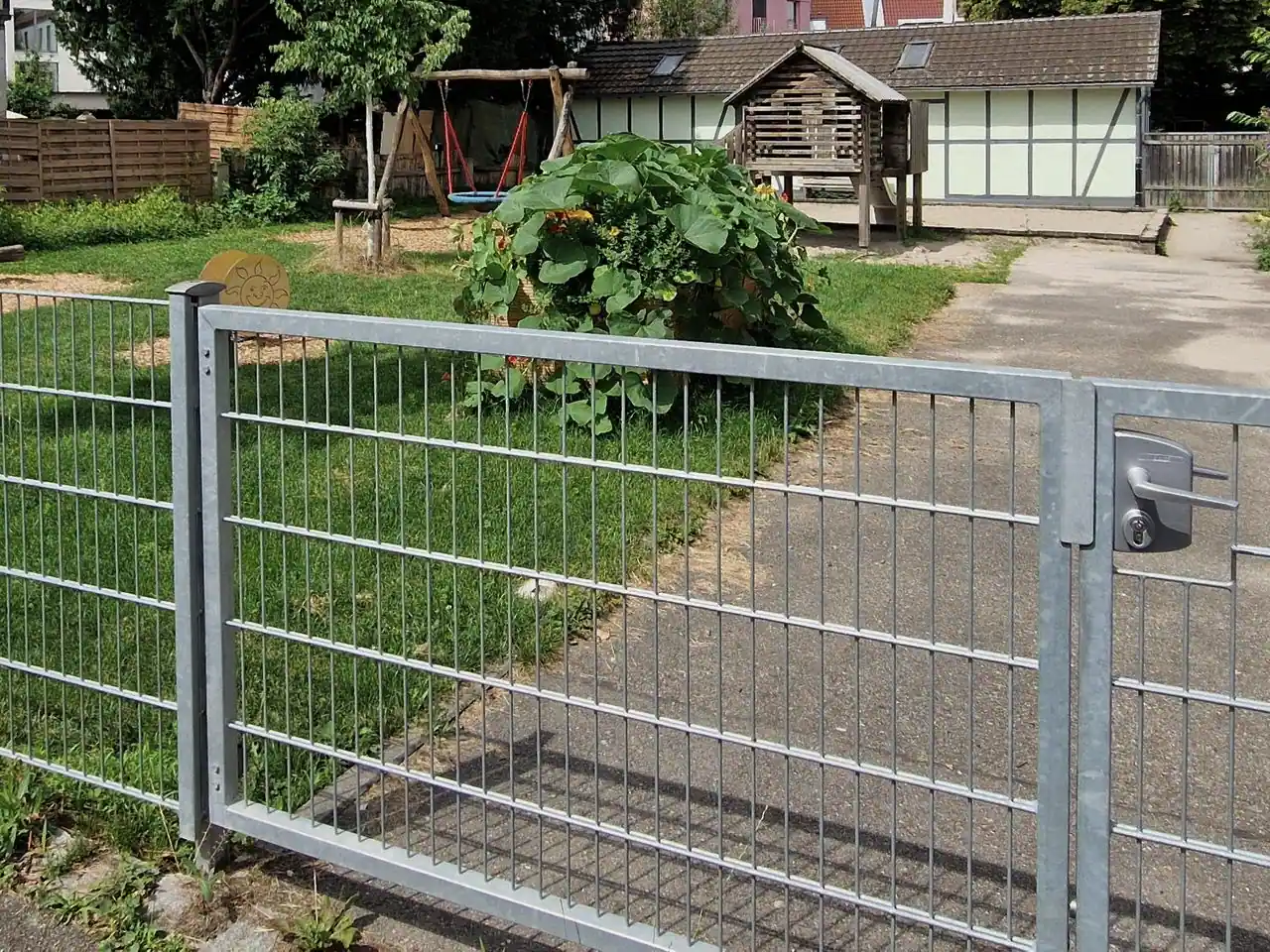
A welded mesh panel fence defines a boundary and stops people from getting through; it does not screen the inside from view. A louvered fence blocks the view with its slats; the price for that is wind load.
It sounds simple, but most misunderstandings at the quote stage start right here. Someone who wants to fence in a plot is surprised when they hear the price of a louvered fence; someone who wants to hide their garden from the neighbors finds, once a mesh panel fence is up, that it doesn’t meet their expectations. The two solve different problems.
Wind: the invisible item that drives the cost
Because a mesh panel fence is made of wire mesh, it catches almost no wind. The wind passes between the wires, and the horizontal force on the posts stays small. The practical result: the posts can be slimmer, they can be spaced farther apart, and the footings are shallower.
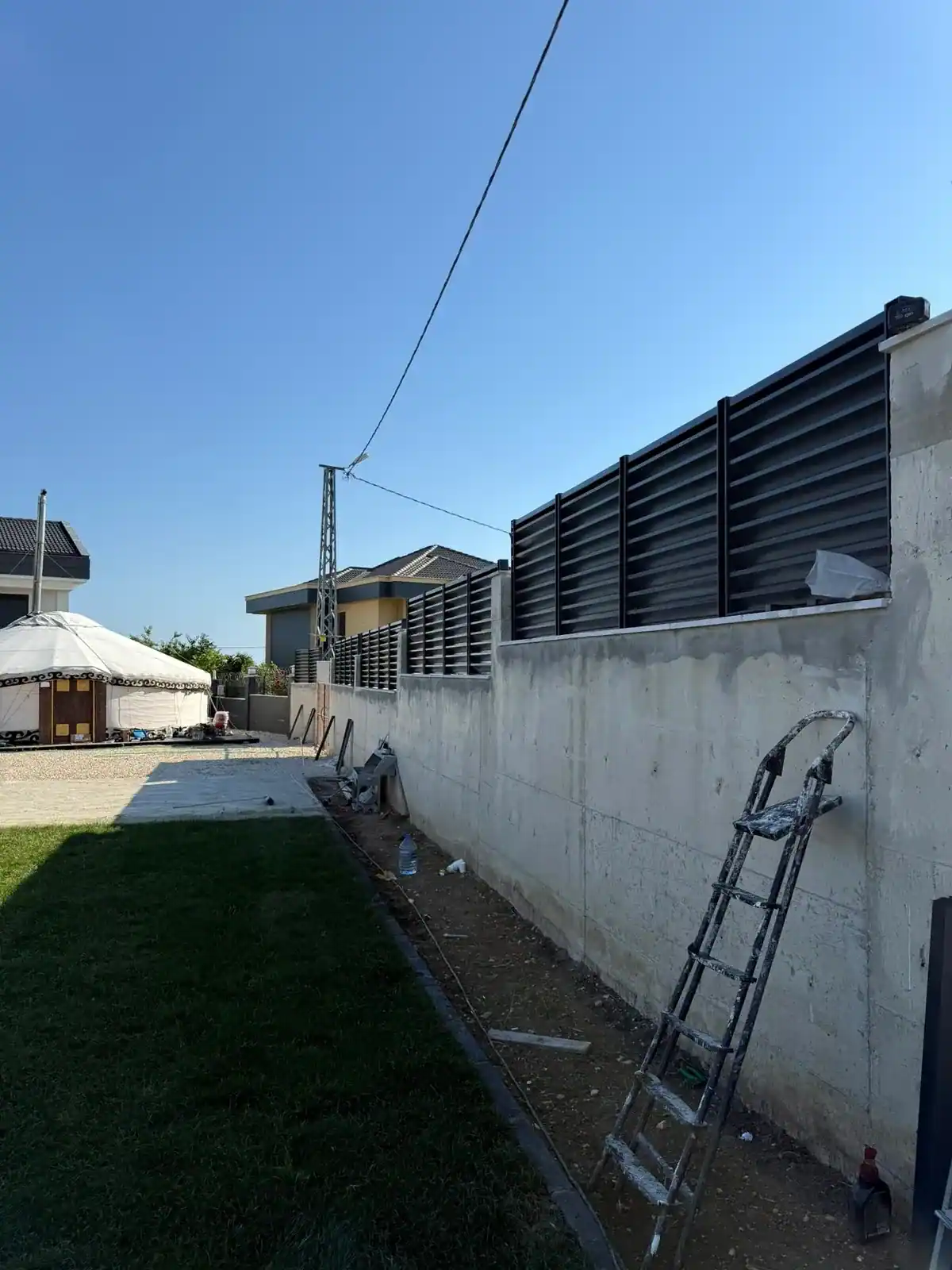
On a louvered fence, the slats form a closed surface, and that surface takes the wind. The force goes straight into the posts and from there into the footings. For a run of the same height, the post section gets noticeably larger, the post spacing gets tighter and the footings get deeper.
That is why using a mesh-panel post on a louvered fence is the most common mistake we see on site, and the most expensive: in the first strong wind the fence line blows over, and the job has to be redone from scratch. On a louvered fence, the post calculation is based on how closed the slats are.
The more closed the surface, the higher the wind load. A fully closed louvered fence carries several times the horizontal force of a mesh panel fence of the same height.
Which one, where?
Around plots and fields
Mesh panel fence. The most economical solution per meter on long runs; there is no need to block the view.
Factory, warehouse and facility sites
Mesh panel fence. If security is needed, a high-security panel with a narrow mesh opening.
Around gardens and pools
Louvered fence. Privacy is the real need here; wind load is factored in.
Boundary with a neighboring plot
Louvered fence. The view is blocked from both sides; the height is set according to the sightlines.
Dividing green areas within a gated community
Mesh panel fence. It stops people from crossing but doesn’t divide the area visually, so the space stays open and airy.
Café / restaurant outdoor seating
Louvered fence. A boundary, a windbreak and a visual identity in one.
Screening AC units, trash bins and service areas
Louvered fence — but with spacing that doesn’t restrict the airflow. A fully closed panel reduces the equipment’s efficiency.
On sloping ground, both follow the same rule
On a sloping run, a fence is installed stepping down in stages rather than raked to follow the slope. Because panels and slats are made rectangular, making them follow the slope means either cutting the panel or distorting the frame, and neither is right.
With stepped installation, each section stays level on its own, and there is a level difference between it and the next section. That difference leaves a gap at the bottom. Whether the gap is acceptable depends on the use: if animals need to be kept from getting through, a concrete curb is built underneath; if appearance is a concern, the step height is reduced and the number of posts increased.
The stepping plan is worked out during the site survey by walking the entire run. A quote based on total meters does not include this plan and is bound to change on site.
Cost: what does the per-meter price hide?
With both systems, quotes are discussed per meter, but the per-meter price does not account for how regular the run is. The items that really determine the total are these:
- Number of corners — each corner means its own post, its own detail and its own labor.
- Level differences and number of steps — on a sloping run, the number of posts goes up.
- Ground — diggable ground, rocky ground and existing concrete each take different work.
- Gates and access points — every opening in the run is a separate piece of fabrication.
- Height — on a louvered fence, height increases the slat area, the post section and the footings all at once.
The cost per meter of a mesh panel fence is noticeably lower than that of a louvered fence, and the gap widens as the height increases — because on a louvered fence, what grows is not just the slats but the entire supporting structure.
Differences in maintenance and lifespan
A galvanized + PVC-coated mesh panel fence needs next to no routine maintenance: it is not painted, and the rain cleans the surface. The only thing to do is to touch up spots where the coating has been damaged — a scratch left by an impact or by someone climbing shortens its life, even while the galvanizing is still protecting it.
On a louvered fence with aluminum slats, the slats do not rust; where the paint is damaged, only the appearance suffers. What really needs checking, though, is not the slats but the anchoring: because wind is a constant and changing load, the anchor bolts should be checked once at the end of the first season.
Louvered fences mounted on top of a wall need one more check: whether cracks are forming on the top surface of the wall. This is the first sign that the anchoring is under strain, and if it is caught early, it can be fixed with simple reinforcement.
Using both together
On most projects, the right answer is not “one or the other” but “which one where.” A louvered fence along the parts of the plot facing the road and the neighbors, with mesh panel fencing on the rear and side boundaries, meets both the budget and the need.
The one thing to watch in this mixed solution is the transition point: where the two systems meet, they share a post, and the color and height are chosen to match. When the gate is made from the same series, the entrance also reads as part of the whole.
Don’t forget the gate in the run
Fence quotes are usually discussed per meter, and the openings in the run come up later as a separate item. Yet the gate is the most-used and most-worn part of the fence.
On a pedestrian gate, the hinges and the lock are what matter; because it opens and closes many times a day, it needs a much sturdier frame than a fence panel. On a vehicle gate, the opening type comes into play: a double-leaf swing gate if there is room to maneuver in front, a sliding gate if not. This decision is independent of the fence itself, but it should be made at the same time.
Making the gate from the same series as the fence is not just about looks: it means the same slat section, the same spacing, the same paint batch and the same installation crew. A gate and a fence bought from different places almost never match exactly in color and texture — and the difference sits right at the entrance, where everyone looks.
Security level: three grades of mesh panel fence
“Mesh panel fence” brings a single product to mind, but there are three different grades depending on the security need, and the difference between them lies more in the mesh opening than in the wire diameter.
Standard mesh opening
For gardens, divisions within a gated community and field boundaries. It marks the boundary and stops people from getting through; it makes no claim to hinder climbing.
Narrow mesh opening
Makes it hard to get a hand or foot in; climbing becomes noticeably more difficult. Preferred around facilities and on warehouse sites.
High-security panel
The narrowest mesh opening and the thickest wire. It makes tampering with hand cutting tools harder. Used at transformer stations, critical facilities and sites holding valuable materials; with this type, the post section and anchoring are specified stronger.
A louvered fence sits outside this scale: its closed surface blocks the view, but it is no more secure against climbing than a mesh panel fence; the slats can be used like steps.
Installation time and site conditions
The two systems also take noticeably different times to install, and this affects planning, especially on long runs.
On a mesh panel fence, the posts are placed in their footings, the concrete is left to set, and then the panels are fitted. Fitting the panels is quick because there is no tensioning; daily progress in meters is high. Digging is the deciding factor: in diggable ground the work moves fast, while in rocky ground the same run can take several times as long.
On a louvered fence, the posts are heavier and the footings deeper, so the digging and concrete stage takes longer. Then the slats are fitted one by one, which is slower work than fitting panels. For the same length, a louvered fence takes noticeably longer than a mesh panel fence.
With both systems, the time the concrete needs to set is a fixed part of the schedule and cannot be rushed. Expecting it to be “done by the weekend” is not realistic on long runs; tell us the length of the run and the ground conditions, and we will give you a realistic schedule.
Installing on top of an existing wall is noticeably quicker because there is no digging; there, the deciding factor is whether the wall can take the anchoring.
Pages related to this article
Let’s talk about your project
This article covers general cases; your entrance, plot or building comes with its own constraints. Send us measurements and photos, and we’ll tell you which solution fits.