
Automatic villa gates: a guide to motors, photocells and safety
An automatic gate is not simply a gate that a motor opens; it is a motor, a safety system and a control setup working together. This article explains what each component does and which ones not to compromise on when you are getting quotes.
The parts of the system: a motor alone is not enough
If the only line item you see on an automatic gate quote is “motor,” the quote is incomplete. A working system has at least five parts, and some of them are there for safety, not convenience.
Motor and control board
The part that produces and manages the movement. The board sets the gate’s opening time, its force and its obstacle detection.
Pair of safety photocells
Stops the gate from closing if there is an obstacle (a person, a vehicle, an animal) in its path. It is a safety component, not an optional extra.
Warning light
Flashes while the gate is moving. It warns anyone approaching, especially at night and on narrow streets.
Remote control and receiver
Opening from a distance. The receiver’s range and the number of remotes that can be paired vary from system to system.
Manual release
The key that frees the motor when the power goes out. Every motor has one; where it is and how to use it are shown at handover.
The photocells and the warning light are not items to drop to cut costs. When a child or a pet is in front of a closing gate, the photocells are the only thing that stops the system.
Choosing the motor: gate weight and frequency of use
Two numbers decide the choice of motor: the weight of the leaf and how many times a day the gate will open and close. A single villa entrance sees eight to ten cycles a day, while at the entrance to a gated community the figure runs into the hundreds. The same motor does not have the same service life in both situations.
Leaf weight is directly tied to the type of infill: a solid leaf clad in composite panel is noticeably heavier than a vertical-bar leaf of the same size. Wind load also adds to the power the motor has to deliver; in a windy location, the motor works harder every time the gate opens.
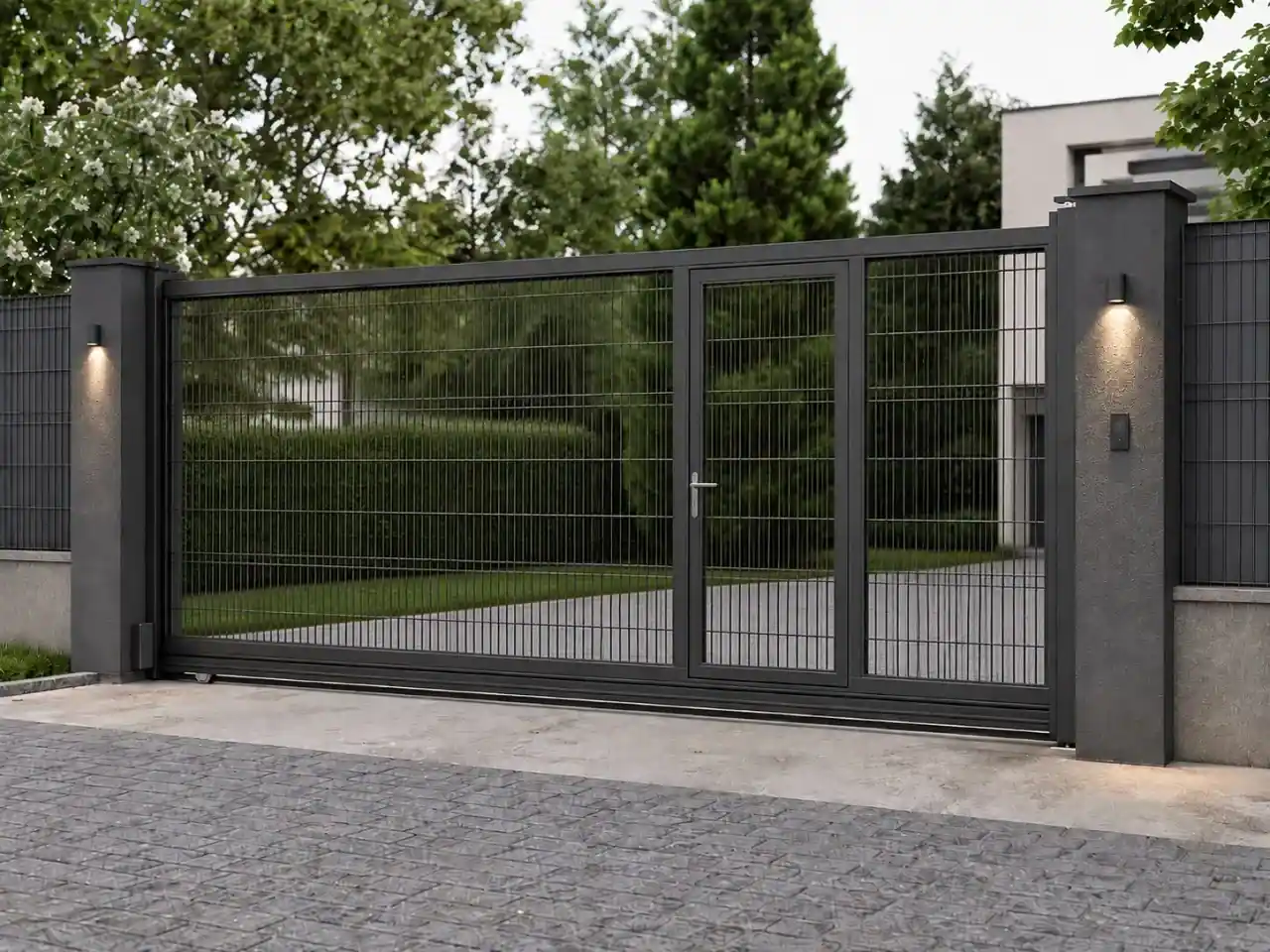
On sliding gates, the motor sits to one side and pushes and pulls the gate by means of a gear rack. A double-leaf swing gate needs a separate motor for each leaf — the ram type is more economical and works where the space between columns is tight; the articulated-arm type gives a smoother movement but needs room in front of the column.
Where do photocells go, and how many pairs do you need?
A photocell set consists of a transmitter and a receiver facing each other; when the beam between them is broken, the gate stops closing or opens again. Correct placement means the beam cuts fully across the gate’s path.
A single pair of photocells is enough for most villa entrances and is usually mounted on the inside of the gate, 40–60 cm above the ground. That height is low enough to detect a child or a pet, and high enough not to be affected by leaves or snow piled up on the ground.
For wide openings, a pair on both the inside and the outside of the gate is recommended: the outer pair sees an approaching vehicle, the inner pair sees an obstacle in the gate’s path. At community entrances with heavy vehicle traffic, these two pairs are standard in practice.
Obstacle detection: the motor senses what the photocells cannot see
Photocells only see the line the beam passes along; they do not notice an obstacle below or above that line. A second layer of protection sits in the control board: when the motor meets more resistance than it expects, it stops and opens again.
This sensitivity is an adjustable value, and it has to be set correctly. A gate set too sensitive will stop and reopen in the wind or even at a leaf caught in the track; a gate set too tolerant will keep pushing into the obstacle. At handover, make sure this setting has been adjusted and shown to you.
What happens in a power cut?
Every motor has a manual release key. The key frees the motor, and the gate is then pushed by hand. This is the system’s most basic safety feature, and where it is and how to use it should be shown at every handover — on the night of a power cut, it is the only thing you will be looking for.
In locations where outages are frequent, battery backup can be added. The gate then keeps running for a limited number of cycles during the outage. A battery is a convenience; it does not replace the manual release but works alongside it.
The same logic applies to the electric lock on the pedestrian gate, and there it is even more critical: an electric lock is always installed together with a mechanical cylinder. A pedestrian gate that opens only electrically leaves you outside during an outage.
Adding a motor to an existing gate
Most existing gates can take a motor, but the mechanical condition has to be put right first. A motor is not an aid that makes the gate easier to move; it is the part that takes over that movement: a gate that sticks when you push it by hand will stick under the motor too, and this time the load falls on the motor.
That is why the track, the wheels and the hinges are checked before installation, and serviced or replaced if necessary. Skip this step and the motor starts to strain within a few months; the fault may show up in the motor itself, but the cause lies in the gate.
The second check is the cabling. If there are no conduits around the gate for the motor supply, the photocells and the warning light, these cables either have to be laid in a trench or run along the surface. If digging is needed, it can be the longest part of the job; it should appear as a separate item on the quote.
Eight questions to ask when getting a quote
- What make and model is the motor, and what leaf weight in kg is it certified for?
- How many pairs of photocells will there be, and where will they go?
- Is the warning light included?
- How many remote controls are supplied, and how is an extra remote paired?
- Is cable conduit needed, and is the digging included in the quote?
- Where is the manual release, and will it be shown at handover?
- Will the obstacle detection sensitivity be set at handover?
- If there is a fault, who comes out, and how quickly?
Comparing two quotes on price before these eight questions have clear answers means comparing two documents that do not describe the same job.
Maintenance: four things to do once a year
An automatic gate is among the lowest-maintenance systems, but it is not maintenance-free. Checking the following once a year prevents most faults before they start:
- Clean the photocell lenses — dust and cobwebs cause false detection.
- Clear leaves and soil from the track; on a sliding gate, this is the most common cause of faults.
- Check how the leaf moves by hand: if it is stiff, the problem is mechanical, not the motor.
- Replace the remote control battery and make sure the manual release key is where it should be.
How will you open the gate? Five access methods
Once the motor and the safety components are settled, the second question follows: how will the gate be opened? Most installations use more than one method together.
Handheld remote
The most common and the cheapest. It stays in the car, and its range is limited. Losing it and a flat battery are the two most frequent problems, which is why a second method is always recommended.
Keypad (code entry)
Wall-mounted, opens with a code. Practical for guests and service staff who have no remote. The code needs changing regularly; a code that stays the same for years provides no security.
Intercom / door phone
Installed together with the pedestrian gate, it lets you open the gate from inside. Add a camera and you can also see who is there.
Phone app
Opening and keeping a log over the internet. It does not work when the internet is down; it should not be installed as the only method.
License plate recognition
A camera reads the vehicle’s plate and opens the gate if the plate is registered. It makes sense at community entrances and under heavy use; for a single villa it usually does not justify the cost.
Whichever method you choose, keep at least one backup besides the remote. The remote’s battery has a way of running out at the worst possible moment.
A villa entrance and a community entrance are not the same system
The same product name can cover two very different uses, and that changes everything from the choice of motor to maintenance frequency.
At a single villa, the gate opens eight to ten times a day. At a community entrance the figure runs into the hundreds; the same motor does not have the same service life in both cases. Under heavy use, the motor’s cycle capacity, its heat tolerance and the availability of spare parts become decisive.
The second difference is safety. At a community entrance where children play and pedestrians pass all the time, a single pair of photocells is not enough; photocells go on both the inside and the outside, and a warning light is non-negotiable. Setting the gate to move slowly is also more a safety decision than a comfort one.
The third is access management: at a community entrance, when a remote is lost, it must be possible to delete that remote from the system. That means choosing the receiver type with this in mind from the start.
Pages related to this article
Models mentioned in this article
Let’s talk about your project
This article covers general cases; your entrance, plot or building comes with its own constraints. Send us measurements and photos, and we’ll tell you which solution fits.